Showing posts with label Bangkok. Show all posts

Saturday, September 6, 2008

Bangkok Ancient City: Muang Boran

The Ancient City, or Muang Boran in Thai, is a relatively little known park dedicated to preserving and promoting the cultural heritage of this country. Located 50 mins driving from the center of Bangkok the best way to get there is by taxi, but of course you have to make sure that the taxi meter is working. In my case only the third taxi “happened” to have the taxi meter working, so the cost was around 300 Bahts; 6 euros one way for a 50 minutes drive, not too expensive really.


The park is a collection of important buildings and historical places from all over Thailand. Even the shape of the park itself resemble the elephant shape of Thailand. There are all kind of temples, stupas, monuments, statues, and many of them on water, just to get that extra beauty effect from your pictures.


The bad news is that everything you see is a replica, and having 109 of them after a while you get used to them, so only the most spectacular ones will catch your attention at the end.
Plenty of good news however: a stroll through the Ancient City will give you first of all a good idea of Thai history and architecture, especially if you don't have time and money to go all over the country. Even better, the park is an incredible quiet and relaxing place; even if you're not into Thai history or architecture is a great chance to get on your bike (provided with the admittance fee) and wander through the 320 acres of the park, stopping whenever you feel like at one one of the many stalls inside for a coffee, drink or lunch.


Almost no cars, (after witnessing a massinve traffic jam in a pedestrian area I wonder if there is a place in Thailand with no cars at all), not many tourist as the place is not well known and away from the city anyway, plus the aforementioned monuments, beautiful lakes, bayan trees, frangipani, and in some areas even deers and strange rugby ball shaped turkeys.


Depending on how long you spend in Bangkok and how much you enjoy noises, traffic, smog and pollution, you might find the Ancient City Park a little slice of paradise.

Read more posts about
Bangkok..

More Thailand stories coming soon, so come back or even better Subscribe by RSS or by Email...

Tuesday, September 2, 2008

Tiger Temple, Kanchanaburi

A good 3 hours by bus from Bangkok is the Kanchanaburi province.
Two of the main attractions there are the Bridge on the river Kwai, famous for sad historical reasons during WWII and the Tiger Temple. The Bridge (and related museum) on its own wouldn't be worth the trip in my opinion, unless you have personal reasons to visit it or you're a big fan of the 1957 famous movie.


The Tiger Temple it's a quite controversial topic. What I knew was that the Buddhist Temple looks after tiger cubs that are orphan or rescued from poachers. The tigers grew up in the temple, and thanks to the monks patience and love they are now accustomed to humans, docile and approachable. You pay a small fee to enter, and a not so small fee if you want (and have the courage to) get very close to them for pictures together. The money however it's all for a good cause, as it will allow the tigers' conservation, and will ultimately provide a Forest Monastery where they can be protected and roam free as they should.


Flicking through an old Lonely Planet guide in my accommodation in Bangkok (I don't use them, actually boycott them, but was curious to see what they said) the Tiger Temple is not only not endorsed there, but readers are discouraged to go there. I took it as an excellent sign. Must definitely be a great place.

So I was quite surprised upon arrival at the Temple to see so many buses and mini-vans parked outside, and so many tourists hanging around. The Temple is now a sanctuary for all kind of animals, so as you enter you see wild pigs, deers, chicken, buffaloes, etc all roaming free together (and with people around) in harmony. Nice, like a Buddhist Garden of Eden.

As you approach the Tiger Canyon, the area where the tigers go in the afternoon to sunbath and take their after lunch nap (and as a consequence the best place and time for visitors to approach them), the first thing that strikes you is a gigantic file of people, all queuing to have a sight and a picture of the tigers. Good news is that if you're willing to pay the extra fee you can skip the queue and have a personal photo shoot with your camera getting very close to the tigers, patting them and even having them on your lap. As you can see from the pics I went for that option, considering that the queue was at least one hour long, and the place was closing in 30 minutes, but mainly keeping in mind that the money is all for a good cause.


That's not the end of the story though. My main inspiration to visit the temple was a website created by two guys who volunteered there. The website explains even better than the official Temple website the philosophy behind the temple, the good causes and the hopes for the tigers' bright future.

Checking back on the website just after few days from my visit to the Temple there was an update. It looks like the Temple by now should have the money for the New Home for Tigers, considering also how popular it got lately. It looks like while before tigers would be left alone if they didnt feel like human company and pictures, now they are forced to perform, a consequence I imagine of the long queue of paying tourist who don't want to be disappointed. It also looks like there cannot be a never ending stream of orphaned cubs, so the Temple must have some other way to get the tigers. And there is also an investigation by Care for the Wild.


Based on the latest news I don't feel like recommending the Tiger Temple anymore. It was great to have tigers on your lap, feel their breath, their muscles, weight (!) and power, but at the same time for the whole length of the visit it felt a bit unnatural, and definitely touristy.

The official proof? Checking on the latest version of Lonely Planet the Temple is now highly recommended!! Avoid.

Related posts:


Bangkok Floating Market : Damnoen Saduak

Bangkok Street Markets and the Art of Bargaining

Bangkok, Attack to Senses

Wednesday, August 27, 2008

Bangkok Floating Market : Damnoen Saduak

A visit to the Floating Market is still a must while in Bangkok.


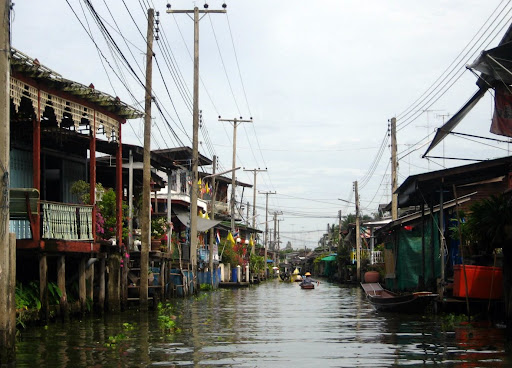
Yes, it's no longer the old traditional market, as now it's more tourist orientated. And it is full of tourists. Still the ratio tourists/local people is not as bad as in some temples or other attractions. You still see a lot of locals buying fruits, vegetables and other stuff from seller on long narrow boats. And although is a less "spontaneous" event now, it is still a great way to see the old style and traditional way of selling and buying on canals.

Located around 80kms away from Bangkok you can get there by car, bus or more easily on one of many mini-van tours, often combining it with the Rose Garden, or the bridge on the River Kwai.

Once there despite the tourists you will really feel like you travelled back in time, and it is a photographer paradise indeed. I have a simple compact digital camera, and still I'm pretty happy with some of the shots I've taken. So let's have the images speak for themselves:


And while you're there make sure to take a long boat to explore the canals away from the market, they go on for miles and miles, no tourist to be seen, but instead real houses, shops and people still living there.


Happy Floating!

Monday, August 25, 2008

Bangkok Street Markets and the Art of Bargaining

Whatever you are looking for, you can be sure to find it on the many stalls on the streets of Bangkok.
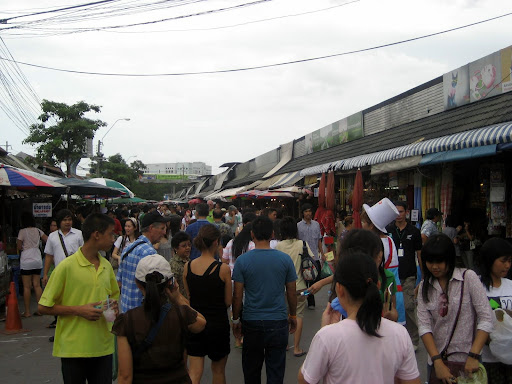
Yes, you can go to some famous markets to begin with; the night market in Patpong (just if you want to pay more for your item as the place is super touristic) or the 24 hours Pratunam market. Or be spoilt for choices at the Chatuchack weekend market; here with 9000 (some say 15000) booths you can be sure to:
- Find whatever you're looking for;
- Spend way more time (if not money) than planned there, also because you will:
- Get lost (map or no map it'll make no difference).

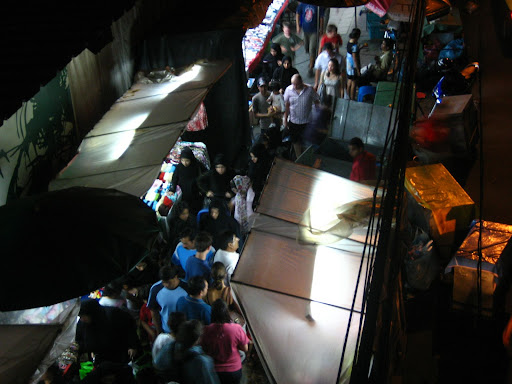
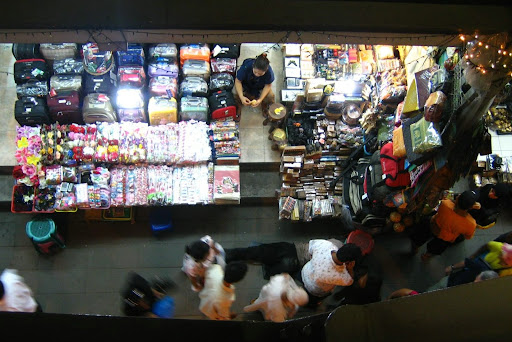
But in case you don't have much time to spend in those markets no need to worry. Every street of Bangkok is a market in a way (anyway).


Being impossible to mention everything on sale in these stalls I'll just try to mention some categories:
Food: of course, the king of street stalls;
Clothing: from underwear to tailor made suits;
Medical: I've seen some fake teeth for sale that looked kind of second hand (or second mouth); I also got offended by a seller who offered me some Viagra! Jaysus, I'm not that old thank you!
Accessories: not only sales but repairs as well of watches, shoes, etc.;
Weapons: butterfly knives, throwing stars, modern crossbows, rifle scopes;
Fakes: from fake Nike and Puma items for sporty people to fake Gucci, D&G and Rolex for the posh ones;
Entertainment: pirates DVDs, games, consoles, i-Pod “lookalikes”;
Sex: from prostitution, to porn DVDs, to “happy ending” massages (read a hilarious story about them here);
Animals: puppies, birds in cages as big as a Rubik's cube, elephants brought in the very heart of the metropolis so people can buy some sugarcanes to feed them.


The last two categories are quite controversial of course. While I feel there's no need to comment on prostitution, the elephants element is a less obvious one. Now I'm no expert in animal rights, but I guess the very centre of Bangkok is not the most ideal environment for a baby elephant (they tend to bring baby ones as they're smaller and cuter). So it might look cute, but if you're in Bangkok NEVER EVER FEED THE ELEPHANTS or you'll be supporting the cruel market behind it.

And speaking of street markets how can we not mention the main activity that relentlessly activity taking place in these streets every minute:

The Art of Bargaining

Yes, as a expected you're a tourist so the first price they'll shoot to you is highly inflated. We all knew that. The surprise can be how much inflated that price can be. Up to 300% if you really look like a tourist (I'm sure my sweating habit contributed as a first impression to at least an extra 50% on the initial price). Some sellers are quite stubborn, so rather than just giving the item to you for a decent price they can prefer to wait for the next gullible tourist.
So it's really up to your skills.


I learnt a lot from a guy i met and hung around for a couple of days.
Originally from Naples (the place that made an art out of bargaining) he lives mainly in Indonesia doing a bit of this and a bit of that. Met him first time in fact on an internal Indonesian flight before bump casually into him in BKK.

Well, this guy will bargain for a good 40 minutes, bring the price down to a quarter of the initial offer; shop owners meanwhile look upset, angry, offended or even as sad as about to cry, depending on the bargaining stile. The great thing about this guy, apart from how much he was able to cut on the price, was that after bringing down the price to a ridiculous amount (read: I'm not a gullible tourist) he would then give a big tip, ending up paying the price offered 15 mins ago (read: I understand your situation, we're friends now, better price next time huh?).

A lot to learn there, but hey, I'm practicing...

Wednesday, August 20, 2008

Bangkok, Attack to Senses

As you arrive Bangkok will deliver a total attack to all of your senses. It might takes a few days to get over it. But once you do you'll really enjoy the fascinating complexity, controversy and variety of this metropolis.

As generally we refer to the five senses I'll try to describe the sensorial attack according to these senses.

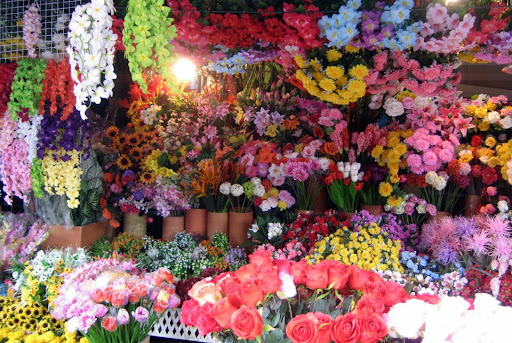
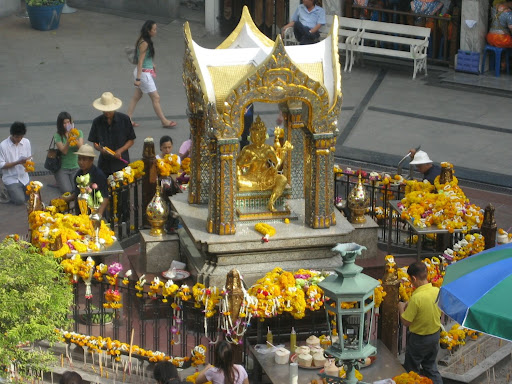
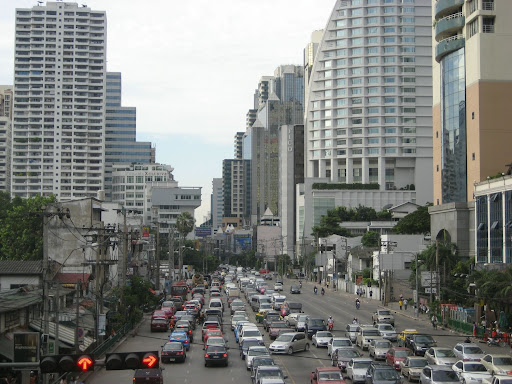
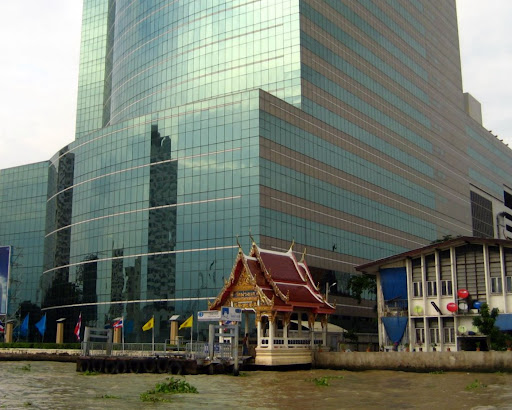
Sight. The grey of the sky, mixed with the concrete-grey of hundreds of skyscrapers, roads, elevated pedestrian bridges and elevated train tracks. This prevalent grey contrasts with the gold of temple and shrines, with the colorful taxis and tuk-tuks, and at night with the thousands colorful neon signs.

Smell. The smell of food from the stalls mixes itself up with the warm stink coming up from the sewers you're walking on concealed as foothpaths; add a quite high amount of pollution as well. One moment you're filling your lounges with the gorgeous smell from the stalls (almost feeling hungry again), one moment you have to cover your mouth and nose and quickly move on.

Hearing. The noise from cars, tuk-tuks and their horns; trains, traffic wardens and their whistles; every seller then try to attract attention with some kind of noise: bells, horns, wooden frogs, clapping their hands, and calling you of course.

Touch. When you think Touch your hands usually come into your mind. The tactile aspect of Bangkok involves all of your body: the heat wrapping around you like a blanket, sweat making you all sticky, and then, when you're almost getting used to it.. Bang! The freezing air conditioned of a bar, shop or train, or the polar environment of a shopping center.

Taste. Do we have to mention the amazing taste of Thai food? A couple of things to mention though:
- Hot Hot Hot. Not really a surprise. However, being used to Indian spiciness i was surprised how much Thai food can burn in your mouth; while with Indian food you feel the heat gently but unstopping glow inside you, with Thai food you feel the heat straight in your mouth.
- Fruits. An amazing variety of new super-tasty fruits like rambutans, longans and mangosteens between the others.


The concept of concrete jungle really applies to Bangkok: in the real jungle the strongest will survive, and often the strongest is the biggest, or more colorful, or louder. In the business-based concrete jungle size, colours and noises are important too. The stronger is often the one who can attract your attention most, in order for you to but their products/services. And like in the real jungle they use size (some huge shopping centres), colours (the neon signs) or (all kind of) noises to attract your attention.